

The Short Answer
Ferritin and haemoglobin are the two key markers for reading iron results. Ferritin shows your iron stores; haemoglobin shows whether deficiency has become anaemia. Low ferritin with normal haemoglobin means you’re iron deficient but not yet anaemic.
You’ve had your blood drawn. The results are in. And now you’re staring at numbers, units, and reference ranges trying to figure out what any of it actually means.
Here’s what the key markers mean, and how to read what you’re looking at.
Key Takeaways
- Ferritin and haemoglobin are the two markers that matter most for iron.
- Ferritin shows your iron stores; haemoglobin shows whether iron deficiency has progressed to anaemia.
- Low ferritin with normal haemoglobin means iron deficient but not yet anaemic.
- MCV, MCH, serum iron and TIBC give supporting clues, not the headline.
- Lab “normal” ranges vary, so read your number in the context of your symptoms.
Which markers matter most for iron deficiency?
There are several markers on a full blood count, but for iron deficiency specifically, the two most relevant are:
- Ferritin — your iron storage protein. This is the primary marker we use to assess iron deficiency.
- Haemoglobin — the oxygen-carrying protein in your red blood cells. This tells us whether iron deficiency has progressed to anaemia.
What do ferritin numbers mean?
Ferritin is measured in micrograms per litre (µg/L) or nanograms per millilitre (ng/mL) — for practical purposes, these are equivalent.
Lab reference ranges for ‘normal’ ferritin vary between laboratories and between countries. This is an important context, because what one lab flags as borderline, another might consider normal. It’s also why it’s worth discussing your specific result with your doctor rather than relying solely on whether a number falls within the reference range printed on your results.
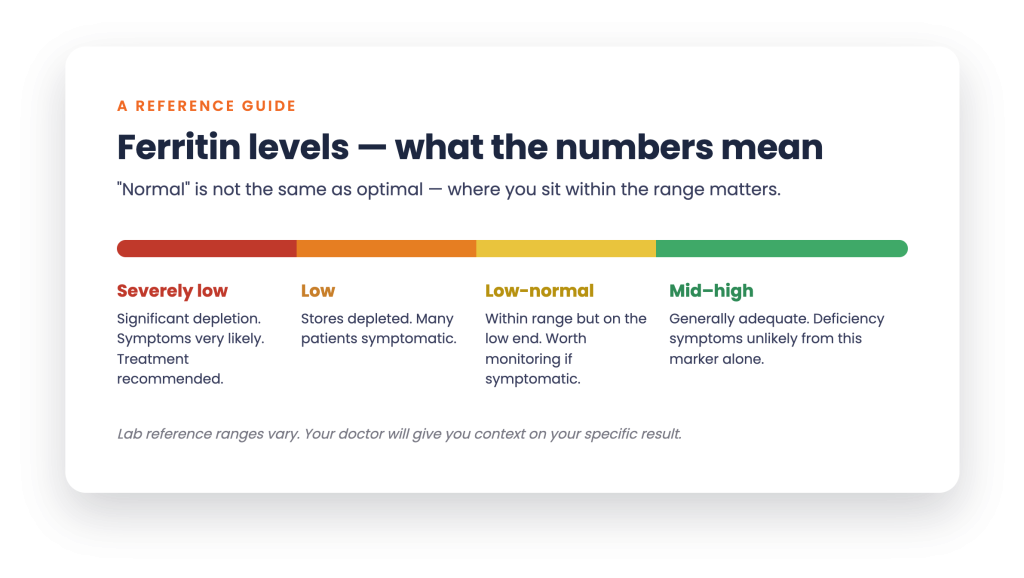
- Severely low ferritin — typically indicates significant iron depletion. Symptoms are very likely and treatment is usually recommended.
- Low ferritin — stores are depleted. Many patients are symptomatic at this level.
- Low-normal ferritin — technically within normal range, but on the lower end. Symptomatic patients at this level are worth monitoring and may benefit from treatment depending on clinical context.
- Mid to high range — generally indicates adequate stores. Less likely to be experiencing iron deficiency symptoms based on this marker alone.
Because ranges vary, we’ll always give you context on your specific result during your visit at New Path rather than expecting you to interpret numbers on your own.
What does haemoglobin tell you?
Haemoglobin is measured in grams per decilitre (g/dL). For women, a result below approximately 12 g/dL is generally considered anaemic, though the exact threshold may vary by lab.
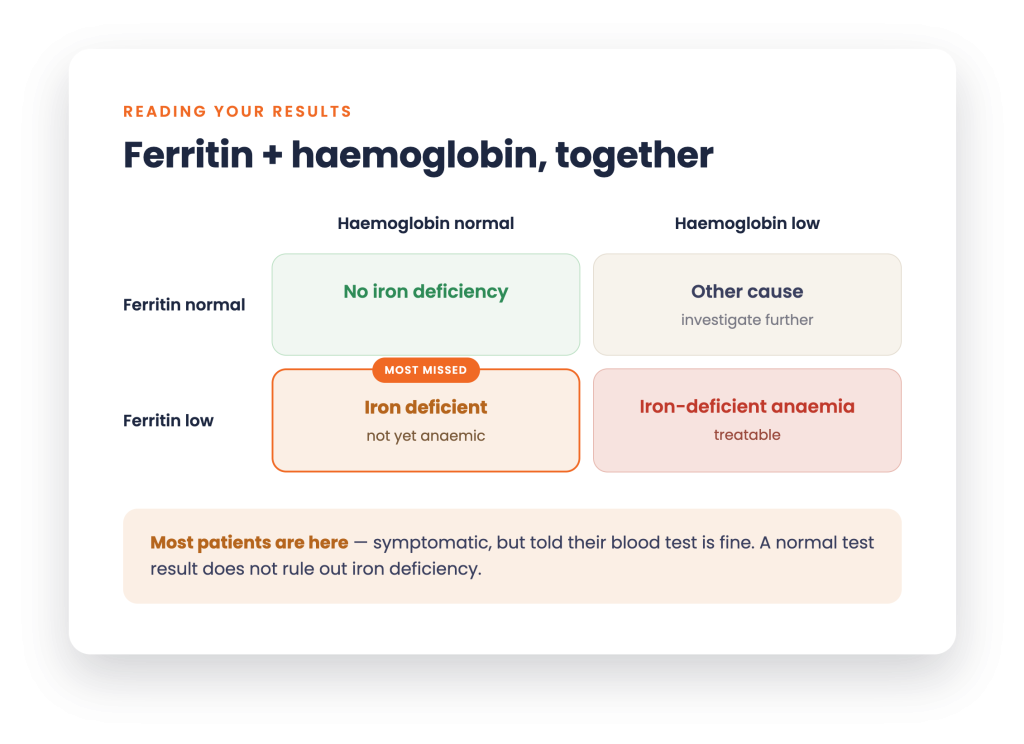
If your haemoglobin is within normal range but your ferritin is low, you’re iron deficient but not yet anaemic. This is the scenario where many patients find themselves — symptomatic, but told their blood test is “normal.”
If both ferritin and haemoglobin are low, you’re anaemic. This doesn’t mean the situation is alarming, because anaemia from iron deficiency is treatable. However, it does typically mean the deficiency has been ongoing for some time, and faster correction is usually recommended.
What other markers might you see?
A full blood count includes several other markers that can provide supporting context:
- MCV (Mean Corpuscular Volume) — measures the size of your red blood cells. Small red blood cells (low MCV) can be a sign of iron deficiency anaemia.
- MCH (Mean Corpuscular Haemoglobin) — measures the amount of haemoglobin per red blood cell. A low value often accompanies iron deficiency.
- Serum iron and TIBC (Total Iron-Binding Capacity) — sometimes included in a more detailed iron panel. Low serum iron with high TIBC is a pattern consistent with iron deficiency.
If any of these markers come back abnormal, they’re useful supporting information — but ferritin and haemoglobin remain the primary indicators.
What happens after your results?
At New Path, we don’t just send you a printout and leave you to figure it out. Once your results are in, we’ll reach out with what they mean and what we recommend.
If you’d like to go through them in more detail, you can schedule a follow-up consult with Dr. Rakesh — in-person or remotely — to walk through your numbers and discuss next steps.
If your ferritin is low, the next step depends on the degree of depletion and your symptoms:
- Mild deficiency — dietary adjustments and oral supplementation may be sufficient
- Moderate to severe deficiency — an iron infusion is often the more reliable and faster route to correction
- Normal ferritin with ongoing symptoms — we’ll look at other potential causes and consider whether there are absorption or lifestyle factors worth investigating
Your results are a starting point, not a verdict. Understanding what your numbers mean, especially in the context of your symptoms and history, is what makes the next step clear rather than overwhelming.
Frequently Asked Questions
How do you read iron blood test results?
Start with ferritin (your iron stores) and haemoglobin (oxygen-carrying capacity). Low ferritin signals deficiency; low haemoglobin signals anaemia. Other markers such as MCV, MCH, serum iron and TIBC add supporting information.
What does low ferritin but normal haemoglobin mean?
It means you’re iron deficient but not yet anaemic. Your stores are depleted, but your body is still maintaining haemoglobin — often the exact point where people feel unwell yet are told their test is “normal.”
What is a normal ferritin level?
Lab reference ranges vary between labs and countries and are set wide. A result on the low end of “normal” with symptoms can still warrant treatment, which is why context matters more than the range alone.
What do MCV and MCH mean on a blood test?
MCV measures red blood cell size and MCH the haemoglobin per cell. Low values often accompany iron deficiency anaemia, supporting ferritin and haemoglobin as the primary markers.
MCV measures red blood cell size and MCH the haemoglobin per cell. Low values often accompany iron deficiency anaemia, supporting ferritin and haemoglobin as the primary markers.
Ready to check your iron?
A simple ferritin test shows what a standard blood test can miss. Our iron deficiency screen checks both ferritin and haemoglobin at just $68 nett. No fasting required, and results available in 1-2 days.


